THE THINGS WE NEVER REGRET
On memory, restoration and making room for life's essentials.
Occasionally I invite prospective clients to visit Woodlands. It is not a showroom. It has never been intended to be one. It is simply our home.
Yet over the years I have noticed something rather curious. People rarely comment first on the cabinetry, the lighting or the craftsmanship. Instead, they often remark on how the house makes them feel. Only afterwards do they begin asking questions. Perhaps that is because a lived-in room reveals something no display setting can. It shows not merely how things were designed, but how they have become part of a life.
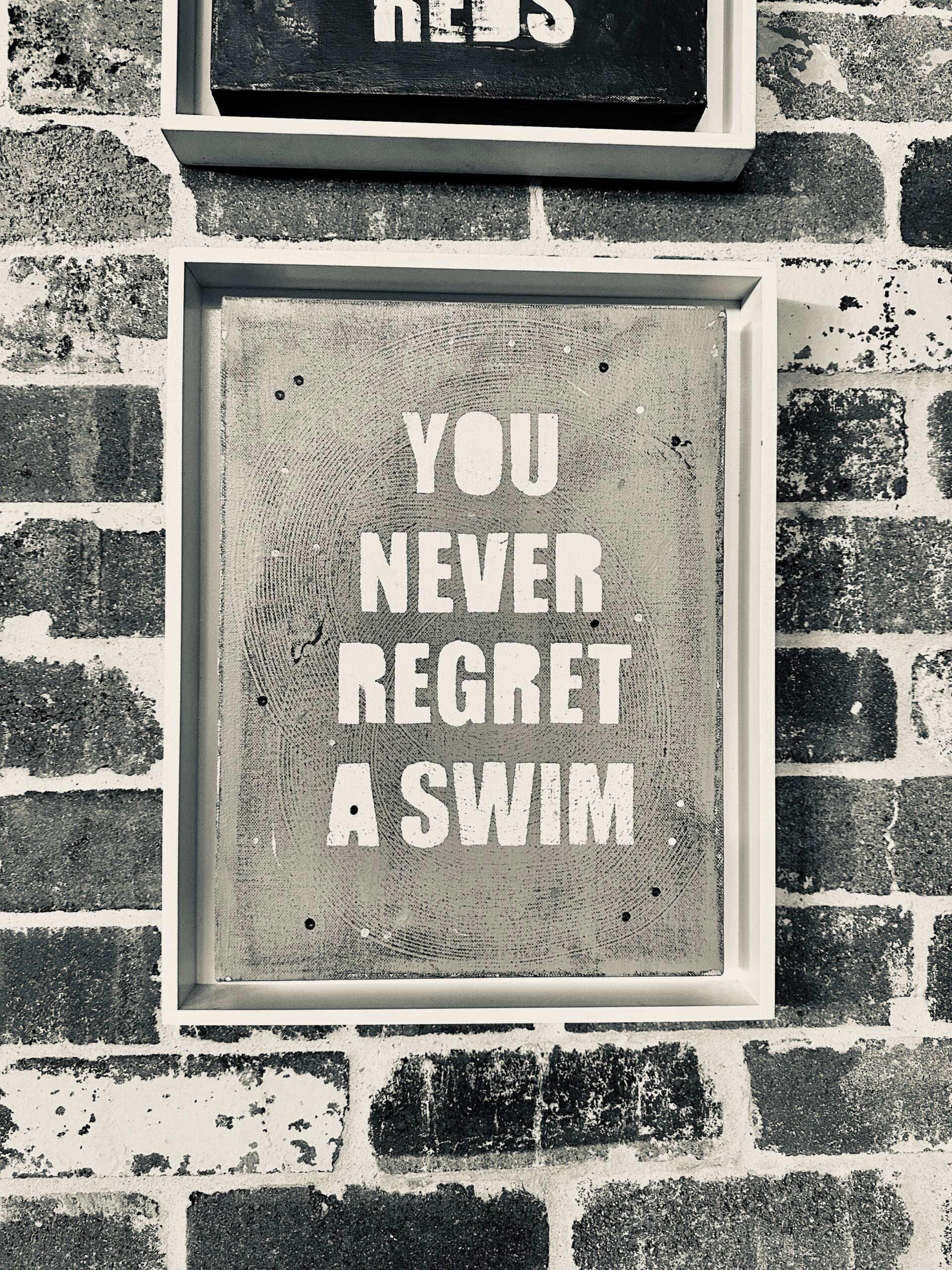
On one of the old brick walls at Woodlands hang three small paintings by an artist friend. They are simple, direct and deeply personal:
You Never Regret a Surf.
You Never Regret Dirty Reds.
You Never Regret a Swim.
Seen together, they read almost like three chapters of a life.
The first takes me back to my early years in Australia, after arriving from England. I spent a great deal of time in the ocean, often surfing alone. Out beyond the breakers, the world seemed to reduce itself to its essentials: wave, breath, sky and the quiet anticipation of what might come next. There was something liberating about it. For a while, nothing else demanded an answer. I never regretted a surf.
The second painting remembers a very different chapter. For about eight years I coached junior rugby at Drummoyne Rugby Club, known affectionately as the Dirty Reds because of the colour of the playing shirts. My youngest son, Harry, was part of the team. Looking back, the rugby itself was only part of what made those years meaningful. There were Saturday mornings, damp playing fields, parents on the sideline and volunteers giving their time without expecting anything in return. There was the pleasure of watching young men grow in confidence, learn resilience and discover what it meant to belong to something larger than themselves. It was community in its most practical form. I never regretted a season with the Dirty Reds.
Swimming came into my life by a less welcome route. For many years I competed in sabre fencing at a senior level. It is an exhilarating sport, but it is also demanding, and eventually I seriously injured my back while training for a major competition. Fencing, I came to accept, is largely a young man's game. I could not return to it. Rehabilitation began with the smallest of movements: simply walking through the water. One slow step followed another. In time, walking became swimming. Swimming became habit. Habit became something much deeper. I remain a swimmer to this day and try to reach the pool daily. What began as rehabilitation eventually became restoration. I never regretted a swim.
Only recently did I recognise that the three paintings share another meaning. This year Oscar and I have faced several design projects that were not difficult because of their size, but because the right answer refused to reveal itself. The proportions would not settle. One solution produced another problem. A drawing could be technically correct and still feel unresolved. Every designer knows that moment. You redraw. You reconsider. You push harder. Nothing improves.
When that happens, I go swimming.
Somewhere between the first lap and the twentieth, the noise begins to fall away. The body finds its rhythm. Breathing becomes measured. Conscious effort gives way to something quieter. Psychologists call it a flow state: a condition of complete absorption in which attention, movement and thought seem to align. Artists, athletes, architects and craftsmen have recognised it for centuries, whether or not they had a name for it. In the pool I am not consciously solving the drawing. Yet somewhere beneath conscious thought, the problem continues to rearrange itself. Quite often, the answer arrives only after I have stopped chasing it.
Good ideas rarely enjoy being chased. They much prefer being discovered.
I have often wondered whether architecture has always depended upon such moments. Did a master mason solve the geometry of a vault while walking home from the cathedral? Did an architect see the answer to a difficult plan while staring across water? Were the great breakthroughs found at the drawing board, or during the moment someone finally stepped away from it? I suspect many were discovered in the spaces between effort.
Architecture itself understands this principle. A successful building is not a relentless accumulation of objects. It depends upon pause, proportion, rhythm and space. The solid matters, but so does the void. What is withheld can be as important as what is shown. Perhaps our thinking works in much the same way. An answer sometimes needs room around it before it can be seen.
That is one reason Woodlands has proved unexpectedly useful when certain clients visit. I do not need to explain every decision. The house speaks through experience. It reveals itself gradually: through light, material, art, unexpected views and the way one space leads to another. Architecture is persuasive not because we describe it well, but because people feel it for themselves.
The paintings on the brick wall do something similar. They are not records of achievements. They are reminders of who I become whenever I make time for the things they represent.
The surf reminds me of possibility.
The Dirty Reds remind me of family, community and giving back.
The swim reminds me that disappointment can quietly become a gift, and that stepping away from a problem is not the same as abandoning it.
We often think buildings preserve memory because they outlast us. I have come to believe they preserve something more intimate. They hold the objects, rituals and reminders that help us remember who we once were, what has mattered to us, and who we still hope to become.
Looking back, perhaps that is what architecture has always been trying to do.
Not impress us, but gently remind us how we might live.
A Closing Thought
As I grow older, I find myself measuring life rather differently. Not by the projects completed, the awards won or even the buildings left behind. Instead, I find myself asking a much simpler question:
What have I never regretted?
A surf.
A season coaching young men.
A swim when my mind needed quiet.
A conversation with Rachel.
Time spent with family.
A good book.
A beautifully designed room.
Curiously, none of the answers involve being busier. All of them involve being more present.
Perhaps that is life's quiet lesson. The things that restore us rarely ask us to hurry.
They simply ask us to turn up.
Beyond the Drawing Board
Reflections from Groth & Sons