BUILDING BLOCKS
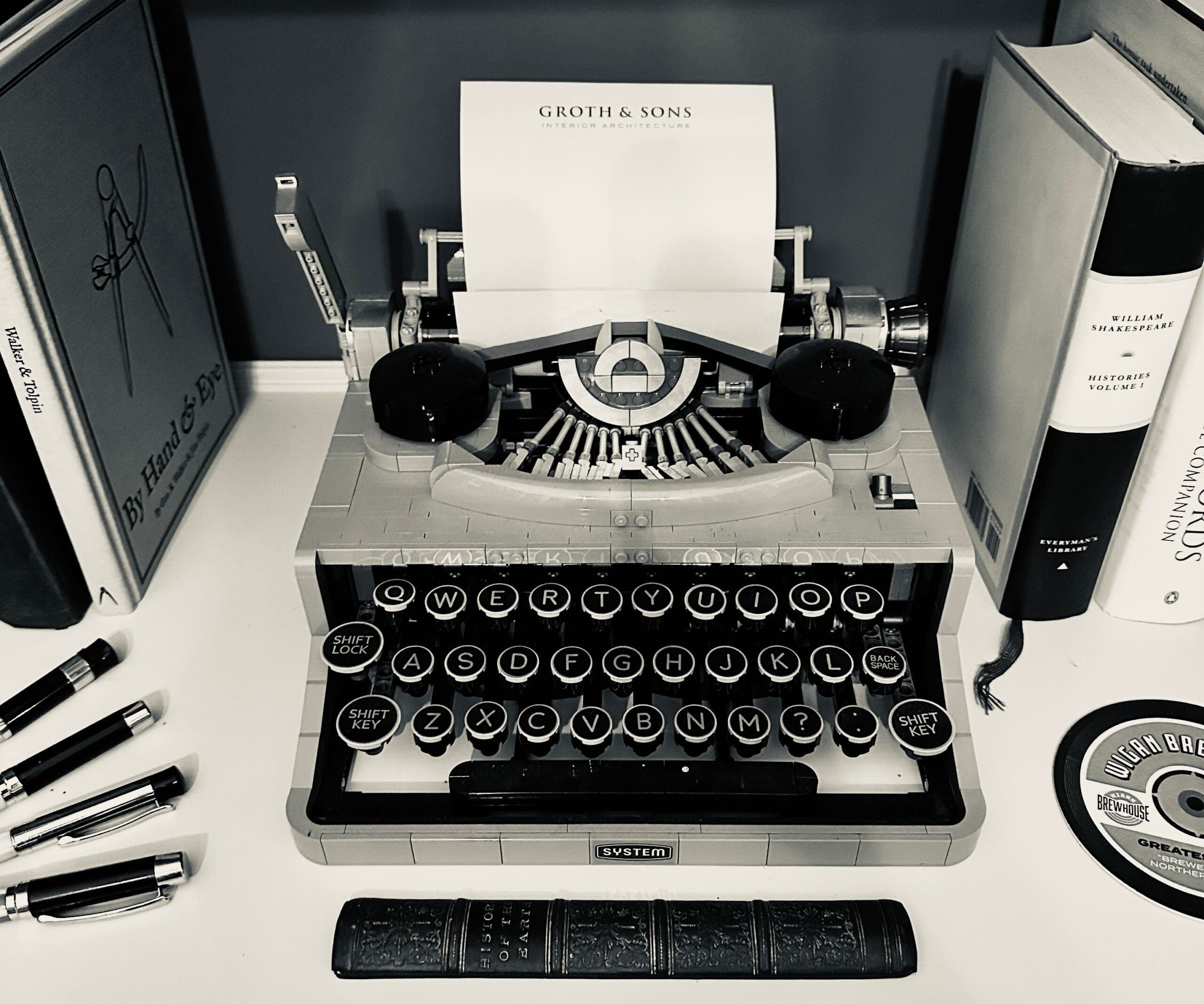
There is a LEGO typewriter sitting amongst the books in my library.
It makes me smile. Partly because it brings together two things that seem to belong to completely different worlds. LEGO belongs to childhood: bricks scattered across the floor, things constructed, dismantled and reconstructed, usually without drawings and quite often without any obvious purpose.
A typewriter belongs to another age altogether: a mechanical object designed to put thoughts onto paper, one deliberate keystroke at a time. Yet perhaps they have more in common than we might imagine.
Both begin with individual elements. A handful of bricks. A collection of letters. On their own they don’t amount to very much. It is what we decide to do with them that matters.
As children, we seem to understand this instinctively. Give a child a box of LEGO and there doesn’t necessarily need to be an outcome. A house becomes a spaceship. A wall becomes a bridge. Something carefully constructed in the morning may be pulled apart after lunch because another possibility has occurred to us.
We call it play. Looking back, I’m not sure it is so different from what designers, writers, artists and makers continue doing throughout their working lives. We take the things available to us and ask: What else could this become?
THE FREEDOM TO PLAY
For a period of my working life, I taught design part-time. One of the most interesting things I noticed had little to do with drawing ability or technical knowledge. It was the way different students approached uncertainty.
Inexperienced designers were often understandably anxious to find the answer. They would develop an idea that appeared to work, lock it in and immediately begin refining it. There was comfort in having made the decision. The blank sheet of paper was no longer blank. They were moving forward.
Except sometimes they had moved forward too quickly. The students who produced the more interesting work were often harder to pin down in the early stages.
They played. They moved things around. They explored ideas that might lead nowhere. They questioned their own assumptions. They were prepared to abandon something they had spent hours developing and begin again.
Sometimes they appeared to be making less progress than everybody else. And then, quite late in the process, something would click. Their final idea was often stronger precisely because they had resisted the temptation to arrive at it too soon.
They had become comfortable saying: I don’t know yet. That can be an extraordinarily useful sentence for a designer.
OPEN MODE
Years later I came across John Cleese talking about creativity. His argument was wonderfully simple: “Creativity is not a talent. It is a way of operating.”
Cleese described two ways of working. The first he called the 'Open mode'. It is relaxed, curious and playful. It allows us to explore a problem without demanding an immediate solution. We can experiment, follow unlikely directions and entertain ideas that may ultimately prove useless.
The second is the 'Closed mode'. Eventually we have to decide. The drawing needs dimensions. The material needs ordering. The machine needs instructions. The cabinet needs building.
There comes a point when asking What if? must become This is what we are going to do. Both modes matter. The difficulty is knowing when to move from one to the other.
What Cleese described immediately reminded me of those design students. The ones who struggled creatively were often entering closed mode too early. The others stayed open for just a little longer. They kept playing.
BUILDING BLOCKS
Perhaps children understand open mode better than most adults. Give a child a pile of building blocks and they don’t begin by asking which solution is correct.
They ask: What happens if I do this? If it doesn’t work, very little has been lost. Pull it apart. Move the pieces. Try again. The brick doesn’t care.
There is no embarrassment in dismantling yesterday’s castle because this morning you have decided it would make a better spaceship.
Somewhere during adulthood, however, we can become frightened of that freedom. We acquire experience, qualifications, responsibilities and deadlines. We become very good at knowing how things should be done. And sometimes that knowledge can prevent us from asking how else they could be done.
Experience is enormously valuable. But perhaps experience works best when it gives us more possibilities rather than fewer.
THE THINGS WE BUILD WITH
A writer works with words. Shakespeare had the same alphabet available to him as everybody else. The remarkable thing wasn’t the letters. It was what he managed to arrange them into.
Architecture works in much the same way. Line. Form. Proportion. Rhythm. Light. Material. None belongs exclusively to the great architect. They are simply the building blocks. What distinguishes one building from another is the judgement with which those elements are brought together.
Cabinetmaking is no different. Timber remains timber. Brass remains brass. Shelves need to support books and doors still have to open. Yet within those apparent limitations lies an almost inexhaustible number of possibilities.
Perhaps creativity has never really been about having more things to work with. Perhaps it is about seeing more possibilities in the things we already have.
THE TOOLS CHANGE
When I began my working life, many of the tools I now use every day simply didn’t exist. Ideas began with pencil and paper. Drawings were made by hand. Dimensions were calculated manually. Much of what happened in the workshop depended upon skills passed from one craftsperson to another.
Today we draw on computers. Three-dimensional modelling allows us to explore things before they exist. CNC machinery can translate those drawings into extraordinarily precise components. Artificial intelligence has become another tool through which we can research, question, write and develop ideas.
It would be easy to see these technologies as the opposite of traditional craftsmanship. I don’t.
A CNC machine doesn’t decide what is worth making any more than a pencil decides what is worth drawing. Technology can give us greater precision, speed and possibility. But it cannot relieve us of the responsibility to think.
The tools change. The thinking still matters.
And perhaps the more sophisticated our tools become, the more important it is that we occasionally retain the mentality of the child sitting on the floor surrounded by LEGO.
Not: What can this machine do? But: What could I do with it?
BAG IT MODE
Writing these BEYOND reflections has unexpectedly reminded me of all this. Almost every one has begun without knowing precisely where it will finish.
There might be a photograph. A memory. A building. Something somebody once said. An experience that has been sitting quietly at the back of my mind for years.
I begin with that and move the pieces around. Paragraphs are written and discarded. An idea I thought was central turns out not to matter very much. Something mentioned almost in passing suddenly reveals itself as the thing the whole reflection was actually about.
I play. Without realising it, I have been working in Cleese’s open mode. But eventually there comes a moment when further exploration stops making the piece better.
The argument has settled. The unnecessary things have fallen away. The reflection has found what it wanted to say.
At Groth & Sons, we have developed our own considerably less academic terminology for Cleese’s closed mode.
We call it: BAG IT MODE.
There is something useful hidden beneath the joke. Open mode requires the confidence not to know. Closed mode requires the judgement to recognise when you know enough.
Move into closed mode too early and an idea may never discover what it could have become. Remain in open mode forever and nothing gets made.
Perhaps part of becoming experienced isn’t learning how to stop playing. It is learning when to stop playing.
A CLOSING THOUGHT
Perhaps we never really stop playing with building blocks. We simply become more ambitious about what we hope to build with them.
The bricks become timber and brass. The pencil becomes CAD. The typewriter becomes a computer.
The tools become more sophisticated and the problems become more complicated. But somewhere underneath the drawings, machinery, technology and accumulated years of experience, the creative process still begins with something remarkably close to the question we asked while sitting on the floor as children:
What can I make with this?
And perhaps the trick is not to grow out of asking it. It is to keep playing long enough to discover an answer worth building.
Then, of course...
bag it.