THE WHOLE IS GREATER THAN THE SUM OF ITS PARTS
There is something reassuring about discovering that an old craft has survived not by refusing to change, but by knowing what is worth preserving.
I was reminded of that recently during a visit to the Hall & Woodhouse brewery in Dorset. Our guide, Trevor, was one of those people I always enjoy meeting: somebody who knows his subject enormously well and, perhaps more importantly, remains genuinely interested in it.
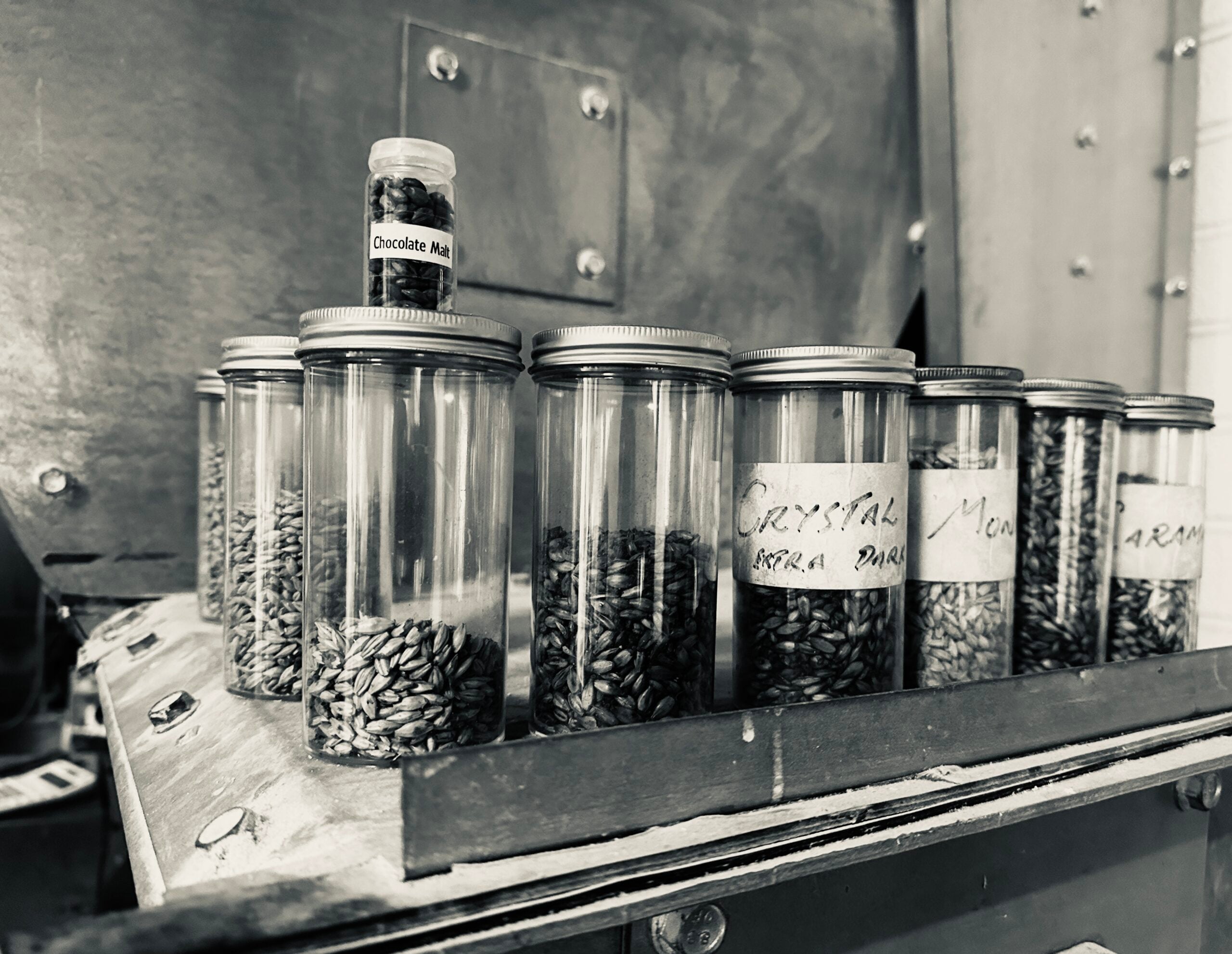
He talked us through malted barley and hops, fermentation and temperature, flavour and bitterness. On one shelf were rows of simple containers holding different grains. To somebody like me, many of them initially looked much the same. To a brewer, they represented an entire vocabulary.
There was malted barley and hops. Yeast. Even the water had its own language: drawn from a nearby aquifer, the brewers referred to it as raw liquor. Then there was temperature. And time. And judgement.
Individually, they were simply ingredients. Bring them together in the right relationships, guided by knowledge accumulated over generations, and they become something else entirely. The whole becomes greater than the sum of its parts.
THE INGREDIENTS AND THE RECIPE
It took me back to something I learnt many years ago at design school: the Elements and Principles of Design. In very simple terms, I suppose they are the ingredients and the recipe.
Line, shape, form, colour, texture and space give us things to work with. Balance, rhythm, proportion, hierarchy and harmony help us understand how those things might relate to one another. But knowing the ingredients does not make somebody a good designer.
You can use beautiful materials, expensive fittings, sophisticated lighting and exquisite finishes and still produce a room that somehow feels wrong. Conversely, relatively humble materials can be brought together in such a way that the result feels completely resolved.
The individual parts matter. But it is their relationship to one another that creates the whole. Perhaps that is where craft really begins.
KNOWING THE RULES
What fascinated me at the brewery was the relationship between tradition and technology. Brewing is ancient, yet the modern brewery surrounding us employed an extraordinary degree of scientific oversight. Temperatures could be controlled precisely. Processes monitored. Variables measured. Consistency maintained.
The traditional craft had not been diminished by technology. It had become better understood.
I recognise that relationship very well. Our own workshop contains tools and techniques that cabinetmakers would have recognised generations ago. It also contains CAD software and CNC machinery that would probably have looked like witchcraft to my grandfather.
I don't see a contradiction. A CNC machine can cut something to remarkable accuracy. It cannot decide whether the thing is worth cutting. That still requires judgement.
Perhaps the more interesting demonstration of this at Hall & Woodhouse was not in the main brewery at all, but in their micro-brewery, where small batches and seasonal ales allow the brewers to experiment. I liked that enormously.
There is an old idea in creative disciplines that you should learn the rules before you start breaking them. I think there is considerable truth in that. Breaking a rule because you don't understand it is one thing. Breaking it because you understand precisely what it does - and are curious about what might happen without it - is something else entirely.
Perhaps mastery eventually earns you permission to play.
The established brewery requires consistency. People return to a familiar ale because they expect it to taste like the ale they remember. But alongside that discipline is a place where somebody can ask: What happens if we try this?
A different grain. A seasonal ingredient. Another balance. A small batch. An experiment. Not every experiment needs to become part of the permanent range. That isn't really the point.
The point is that curiosity is still alive. A tradition that is afraid to experiment eventually becomes preservation. A living craft continues to ask questions.
FROM PROCESS TO EXPERIENCE
A few days earlier, Rachel and I had visited Salisbury Cathedral and Old Sarum. We stopped for lunch at the Bishop's Mill, a building with connections to milling on the site stretching back centuries.
The lunch was excellent. But when I think about why I enjoyed it so much, the food was only part of the answer. There was the building itself. The riverside setting. The history. A good ale. The atmosphere. The service. And, of course, the person sitting opposite me.
Together they created an experience that none of them could have created independently. It made me think about hospitality more generally.
I don't believe most of us go to a good restaurant simply because we are incapable of cooking ourselves a decent meal. Good food matters enormously, but for me it is almost a given. What distinguishes the places I return to is everything surrounding it.
The welcome. The service. The room. The lighting. The acoustics. The pace. The knowledge of the people looking after you. Those almost invisible moments when somebody has anticipated what you might need without making a performance of doing so.
The best hospitality has been designed, whether we consciously notice it or not. And perhaps the highest compliment is that we don't notice the design at all. We simply remember how the place made us feel.
MAKING THE COMPLEX FEEL SIMPLE
I have come to think that good interiors work in much the same way. A beautifully made cabinet is not enough. Nor is the right timber, perfect proportion, an elegant piece of hardware or carefully considered lighting. They are ingredients.
At Groth & Sons, the finished room is really only one part of what we make. There is the first conversation. The consultation. Listening to how somebody lives. Drawing. Questioning. Revising. Choosing materials. Solving problems. Manufacturing. Finishing. Installation.
There may be hundreds of decisions behind a relatively simple-looking piece of joinery. But the client shouldn't have to experience those hundreds of decisions. Ideally, the complexity disappears.
A secret door simply opens. A light comes on. A ladder rolls to where it is needed. A book sits exactly where somebody instinctively reaches for it.
And eventually we leave. The client fills the shelves, puts something on the desk, leaves a pair of glasses beside a book and begins adding the one ingredient we could never supply. Their life.
Perhaps that is when the design is finally complete.
MORE THAN MAKING THINGS
The brewery visit reminded me that the things we make are rarely experienced in isolation. Beer becomes part of a conversation. Food becomes part of an evening. A room becomes part of a life.
And perhaps that is why the individual components, however beautifully made, can never entirely explain the finished experience. There is something else in the spaces between them.
Relationship. Timing. Context. Memory. People.
Maybe that is what designers, brewers, chefs, craftspeople and good hosts are really working with. Not simply things. Relationships between things.
A CLOSING THOUGHT
Perhaps the whole becomes greater than the sum of its parts when we stop thinking only about the parts.
The ingredients matter. The knowledge matters. The skill matters. The setting matters. The service matters. And the people certainly matter.
But the magic is rarely contained in any one of them. It happens somewhere in the relationship between them.
Perhaps that is true of a good ale, a memorable meal, a beautiful room - and quite a few other things besides.
We may make the parts.
What people remember is the whole.